


)
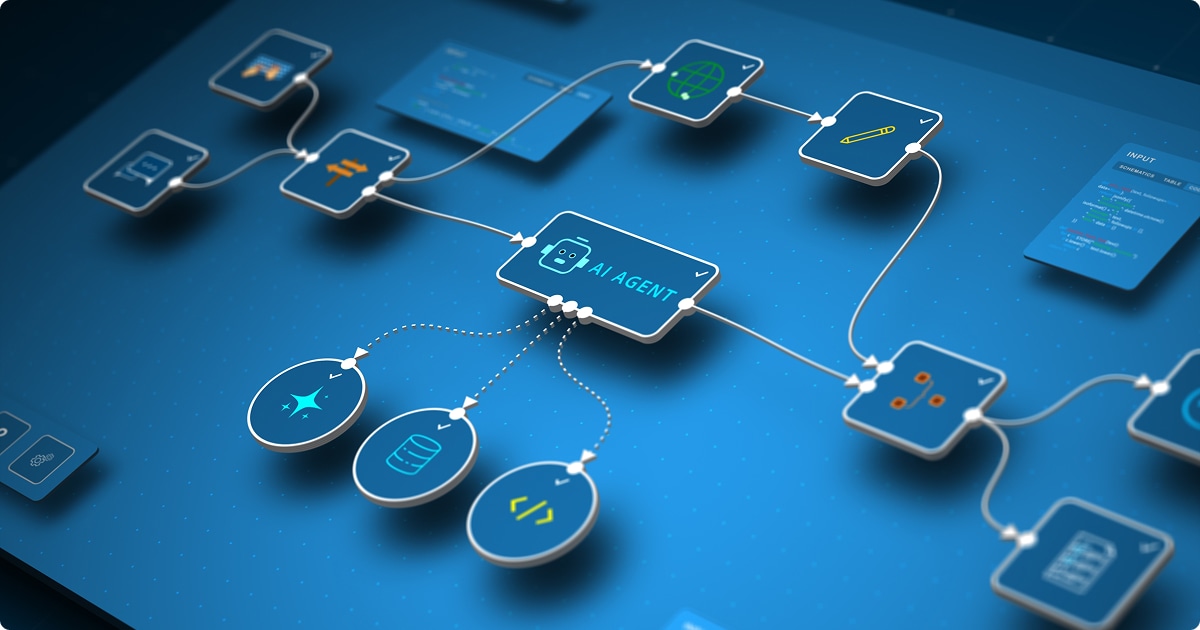
We are witnessing a marked shift in AI usage from information retrieval to insight-driven intelligence, moving us from AI assistants to AI Agents deeply embedded in tech. Able to save time, operating costs and stress, it’s not surprising that tech innovators are increasingly looking beyond assistants towards intelligent agentic systems that support complex business decisions. MCP servers are foundational when it comes to connecting interfaces with data, but there is a need for a more structured toolkit with deeper workflow capabilities if we’re really going to enhance decision-making with AI. That’s why we’ve introduced the TomTom Agent Toolkit – now available through our Maps SDK.
Geolocation and mapping data have far more applications than routing and navigation. Yet, for years, accessing any meaningful and detailed geolocation insights required specialist tools. A query by a GIS analyst, a dashboard built for a planner, a web application for a carmaker or fleet manager – extracting value from the data meant juggling multiple reports and systems before information could be found, analyzed and actioned. AI and its agentic capabilities are changing all that.
The shift from assistants to embedded agents
It’s important to note the difference between AI assistants and agents. While AI assistants, such as TomTom AI Assistant (TAIA), work on the front end, AI Agents are deeply embedded in the architecture to provide answers to complex questions. TAIA is an agent created by TomTom, but the Agent Toolkit is what someone else's agent uses to become spatially intelligent.
Imagine an insurance underwriter in claims, they can ask, “Which open claims sit within 500m of last night’s flood zone and inside our coverage area?” Or a city planner can prompt, “Find out the change in estimated travel times near the central bridge by cross-referencing it with closures and road works for last 6 months” or a dispatcher could type, “Reroute the trucks stuck behind the A12 incident through depots with capacity before 4pm”.
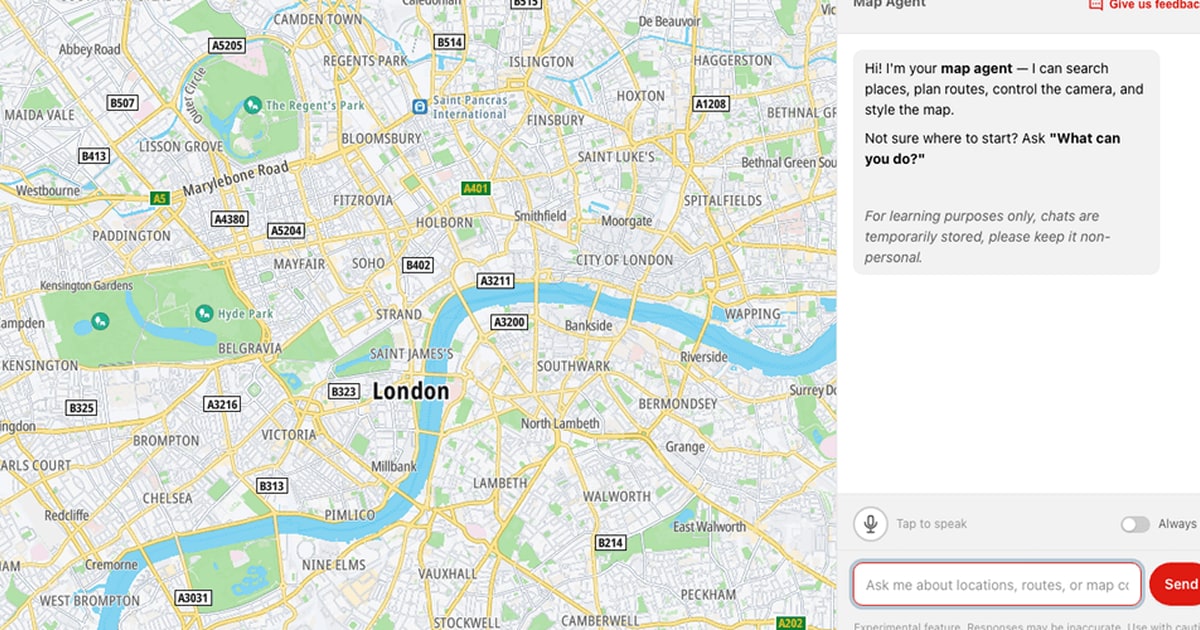
In the agentic era, the conversation is the interface, and the map is one of the many capabilities behind it. As AI expert Andrej Karpathy declared, “The hottest new programming language is English”, a sentiment that is now readily accepted by engineers, coders, planners and business leaders. Tools like TomTom’s Agent Toolkit in Maps SDK are a step towards this paradigm.
The path from ideas to reality
New ideas take hold of the tech-sphere every now and then, but as with any tech there are steps to complete before the ideas become scalable and tools become usable. When it comes to building such tools, the answer is far from easy. To build an Agentic AI with the capabilities to solve complex use cases with multiple instructions, the requirements can be broadly seen in two areas: data and workflow
Accurate data: To ground the agent in real, validated
and right information for correct, contextual answersA structured workflow: The multi-step process the AI agent undertakes to understand the context, access right data and derive the correct answer
Head to the Docs to get in-depth understanding of TomTom Agent Toolkit. Find everything you need to start building.
Intelligence that makes AI smarter
Wrong output, irrelevant information or hallucinations are problems the entire AI tech industry is trying to solve. But not everyone is equipped with the one element that can solve this: ownable, rich, accurate and powerful data that can ground AI tools in reality. Good data is paramount for the accuracy and success of AI agents.
At TomTom, we’ve been dealing with big data and machine learning for decades. We’ve been working on and evolving the foundations of AI tools long before it became a buzzword. As one of the earliest digital mapmakers, TomTom has archived 2.8 trillion kms of global distance data, trillions of GPS points, and continues to gather vast amounts of live driving data every single day. Add to this the billions of data points we ingest to build our location analytics, and you will see — big data can’t get any bigger than global map data. Using this vast amount of data, TomTom has built sophisticated analytical models, used deep machine learning and consistently delivered useful location-based products.
All this data is validated and continuously updated to keep it accurate and real-time —Orbis maps are built on this strategy. And it’s this truly valuable and unique data that gives contextual accuracy to AI agents.
This kind of data is the biggest asset any organization can have in the modern day, and only a few can claim to have it.
Once the data foundation is covered, the next element to make AI Agents perform well and provide relevant, contextual output requires analytical systems and workflow embedded into its logic.

Solving the workflow problem
The Agent Toolkit is a plugin that lets any AI agent perform sophisticated tasks — like finding locations, calculating reachable areas, searching nearby places, and routing with live traffic — all triggered by a simple plain English request. Instead of a user having to manually connect each of these capabilities, the toolkit chains them together automatically (using 53 different tools to be specific) and displays the results on a live map. Think of it as giving an AI agent a fully equipped cognitive and context-aware functionality, ready to use out of the box. To get a deeper understanding of how it works, check out this article on our Docs.
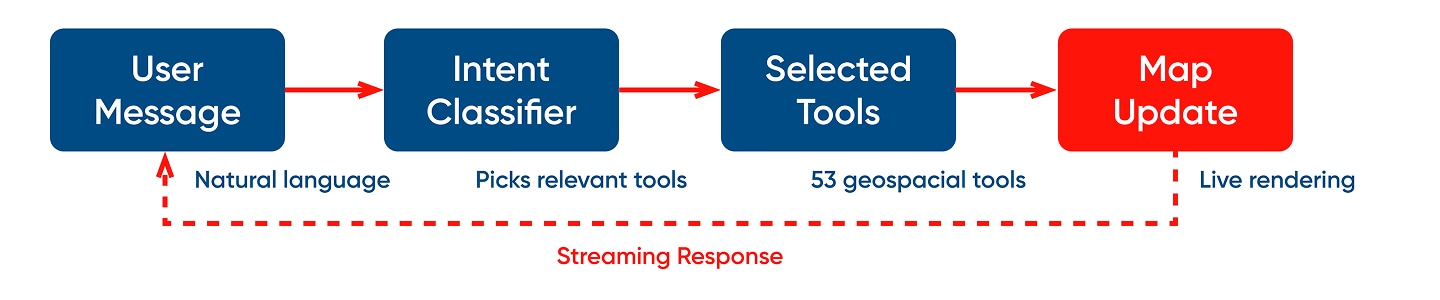
It goes beyond an MCP server. Most mapping providers are making their services accessible to AI agents, but that only solves half the problem. The harder part is all the invisible correlation that has to be built — interpreting what the user actually wants, managing the sequence of tasks, keeping everything in sync. The Agent Toolkit handles these correlations, so development teams can focus on their own product instead of reinventing the same workflow every time, for every request.
The grounding layer for higher ambitions
Today, AI is revolutionizing not one, not a handful, but almost every industry. We are at an inflection point, similar to the internet or smartphone revolution. Organizations that adapt and build with this new technology are the ones that will have a larger share in the future growth and a place amongst the innovators.
Real, validated and accurate data is the catalyst for creating AI tools that truly work and can be trusted. TomTom, with its vast amounts of accurately maintained big data, is in a unique position. Today we are building a spatial layer of intelligence for the world of AI agents. Tools and products that are designed for this new world of AI. Because sky-high ambitions can only be realized if they have deep foundations.
People also read
)
Connecting to the world of AI agents: Introducing TomTom Model Context Protocol Server
)
25 years of GPS going public: How this tech policy changed maps and navigation forever
)
TomTom’s AI strategy is already improving customer experiences — here’s how
)
Mapmaking in the AI age: How TomTom builds maps you can trust
* Required field. By submitting your contact details to TomTom, you agree that we can contact you about marketing offers, newsletters, or to invite you to webinars and events. We could further personalize the content that you receive via cookies. You can unsubscribe at any time by the link included in our emails. Review our privacy policy. You can also browse our newsletter archive here.